Who Will Speak for Me? Webinar on Planning for the Future Without Children, April 8

SAIDO Learning Benefits Memory Care Residents

In 2001, SAIDO Learning was developed as a method to disrupt the symptoms of memory decline. This year, the Japanese-founded model of care for Alzheimer’s and dementia has found its way to Heron’s Key.

By consistently using reading comprehension, writing and arithmetic exercises repeatedly every day, Heron’s Key residents living in Penrose Harbor have been able to improve symptoms of cognitive decline. Through functional brain imaging research, it was found that the brain is mostly activated by three important factors: reading aloud, solving simple math problems, and positive communication and praise.

Penrose Harbor residents are called the “Learners” in this program and the staff members are the “Supporters”. Each day for 30 minutes, two Learners meet with a Supporter to engage in SAIDO Learning.

residents engaged with SAIDO

The Learners will complete worksheets and write the time it takes them to complete them when finished. After finishing the task, the Learner will receive a big “100” every time on their paper which provides immediate feedback and praise, a key principle of SAIDO Learning. While the typical education system grades are based off percentage correct, SAIDO is not academic. The object is for them to engage in repeated successful accomplishment of basic material, then move on to new material at their own individual level and pace.

By completing the assignments and receiving their 100s, residents are engaged in meaningful, positive interactions. This ultimately interrupts symptoms of memory decline while also increasing energy, improving memory, and helping residents gain a larger social capacity and more confidence.

When the lessons become too easy for the Learner, they are bumped up to a slightly more difficult “just right” level. The goal of SAIDO is not to teach the residents new information, but to engage them in mental stimulation while providing positive encouragement and bonding with other residents and staff.

Currently, four Penrose Harbor residents are involved in the SAIDO Learning program. Their loved ones are already seeing a huge difference in their disposition and memory capacity. Heron’s Key is looking forward to training more staff members to be involved in SAIDO and ultimately help more residents.

One of the best parts of SAIDO training is that all Heron’s Key staff members, regardless of their work area, can participate in SAIDO with residents. Employees who do not have daily interactions with residents enjoy the opportunity to get to know residents in a more personal setting and help in ways outside of their regular sector.

Heron’s Key also received a grant to ensure staff members have SAIDO training and will continue to use these funds with additional training throughout the year. Sandi Semler, Heron’s Key Social Services Coordinator and SAIDO Chief Lead Supporter and trainer, has several trainings already scheduled to engage more staff members in the SAIDO Learning program.

In just a few months, SAIDO has made a huge impact on the residents, their families and the staff members. The program is continuing to grow at Heron’s Key and Sandi hopes their progress will impact other senior living communities across the Puget Sound.

Anyone Can Soak Up the Benefits of Forest Bathing and Sound Bathing — Including You!

As a senior living community, we’re always on the search for activities our residents can engage in that support healthy aging, especially ones that are accessible to essentially everyone.

Katie Lodge, who joined Heron’s Key in June as a fitness specialist, introduced a couple of wellness programs recently that not only support healthy aging but also have generated considerable excitement for residents and our staff: forest bathing and sound bathing.

Both activities harmonize with our holistic approach to wellness, as they benefit mental, physical, emotional and spiritual health. Each person has a unique experience during the activity, even though the sessions are held as a group — so there’s a social aspect as well.

Forest Bathing: An Exercise in How to Be Healthy by Being in the Present

Yoga and meditation are both mindful practices. They help alleviate stress and anxiety by encouraging the practitioner to focus on the immediate moment at hand — the now. Forest bathing works in a similar way.

How to Forest Bathe

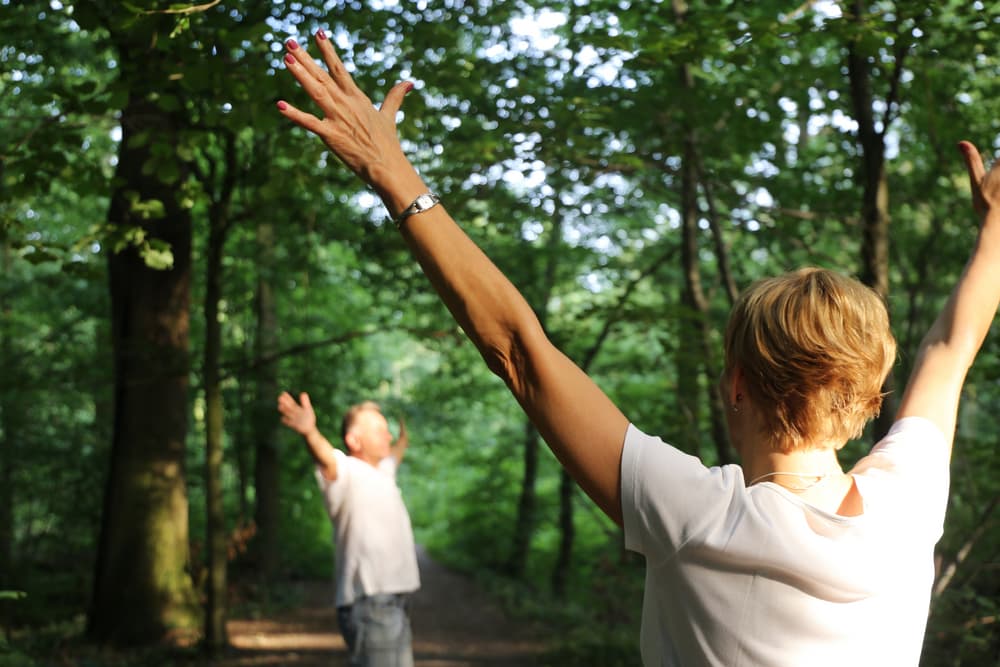
What makes forest bathing such an excellent form of relaxation is its simplicity. You don’t need any equipment. You don’t need special clothing or shoes, though you’ll want to be comfortably dressed. (Yes, this bathing you do fully clothed!) You don’t even need a forest, really.

Fortunately, we have plenty of forests here in the Pacific Northwest, so we’re more than happy to practice forest bathing in its traditional form.

The whole idea is to find a place with trees where you can use all of your senses to immerse yourself in your surroundings. It could be a park or even a stand of trees in a residential area.

Leave your camera at home or in the car. If you aren’t comfortable leaving your cellphone behind, at least turn it off.

Walk slowly — you’re not out for a hike — or find a spot to be still. Listen to the sounds around you. The birdsong. The sound of the wind in the trees. Maybe there’s a stream or a brook nearby.

Notice the multitude of hues, the greens of the grass, moss and leaves (or the magnificent reds, oranges and golds of the foliage this time of year). Peer into the sky. Is it a beautiful, clear blue, or are there clouds drifting by? Are there shafts of sunlight streaming through the trees?

If you’re in a pine forest, breathe in the fresh clean scent. If you’re in a park, do you smell the fragrance of flowering plants? If there’s a body of water close by, can you smell it? As you breathe in the air, can you taste it, too?

Give your fingers permission to participate. Let them feel the texture of the tree bark, the leaves, the grass.

If there’s a breeze, notice how it feels against your skin and in your hair. Does the air feel (and smell) damp, or does it feel crisp?

Pay attention to what all of your senses are telling you.

A Quick History

Forest bathing originated as a form of ecotherapy in the 1980s in Japan, where it’s called shinrin-yoku. The director of the Japanese Ministry of Agriculture, Forestry and Fishing coined the term and helped establish the practice as a therapeutic way for people to reconnect with nature. He also saw shinrin-yoku as a means to protect the country’s forests.

The concept behind forest bathing is much older, though. For millennia, people have turned to nature to soothe and heal themselves.

Today, urban planners know the importance of including green spaces, such as parks and gardens, where people can get outside and enjoy nature.

The Health Benefits of Forest Bathing

Research suggests forest bathing is more than a pleasant pastime. Although studies so far have been small and have limitations, they indicate forest bathing may:

  • Decrease concentration of the stress hormone cortisol
  • Lower blood pressure and heart rate
  • Boost immune function
  • Improve mood and energy level
  • Increase focus, mental clarity and, potentially, cognitive functioning
  • Promote better sleep

Trees — especially evergreens — and other plants release compounds called phytoncides to protect themselves from insects and disease. When we breathe in these compounds, which are basically airborne essential oils, our bodies increase the number and activity of natural killer cells, a type of white blood cell. As their name implies, these cells kill tumor- and virus-infected cells. This is how forest bathing is believed to improve immune function.

Forest air is also purer, in general, as trees absorb carbon dioxide and release oxygen.

Forest Bathing at Heron’s Key

For our first-ever forest bathing session, Katie and Chuck Hammonds, another fitness specialist here at Heron’s Key, took more than 20 enthusiastic residents to the Japanese garden in Tacoma in August.

For the September session, they stayed closer to home, here in Gig Harbor — where there’s definitely no shortage of forests. About the same number of residents participated. The next outing is planned for Bainbridge Island.

“It was a really pleasant surprise, to see how many people were open to trying it for the first time, and then how many people came back for the second session,” Katie says. “We’re hearing good feedback — the only complaint was that the sessions weren’t long enough!”

Katie notes the sessions are structured enough so that residents have a guide if they want it, but everyone has the opportunity to “get what they need while they’re out there.”

For now, the plan is to go forest bathing monthly, weather permitting, and eventually the sessions may be extended with a yoga class or maybe a picnic, according to Katie.

Sound Bathing: Let the Good Vibrations Begin!

Although various forms of sound therapy have been around for thousands of years, sound bathing in the U.S. has mostly been used for meditation and as a healing activity in yoga studios and wellness centers.

To a lesser extent, sound bathing is also being used as a form of treatment for people living with Parkinson’s disease and Lewy body dementia.

In a sound bathing session, the person leading the session plays a therapeutic instrument such as a sound bowl, also called a singing bowl. Whether they’re made of crystal or metal, these bowls produce sound through vibrations — like a gong, a chime or a bell.

Those who are participating in a sound bathing session either sit comfortably or lie down, using blankets and bolsters to make themselves comfortable. As the tones from the bowls resonate throughout the room, participants focus on the sound, letting go of stress and negative thoughts.

Proponents of sound bathing suggest the frequencies of the vibrations help to balance the body’s energy centers so that energy can flow as it should. Potential benefits include:

  • A sense of calmness
  • Less muscle tension
  • Better sleep
  • Pain relief
  • Improved mood
  • Lower blood pressure

Session #1, a Resounding Success

Heron’s Key recently had our first sound bathing session, and the room was full! We even had a waiting list of those wanting to participate.

“It was really cool to see how open-minded everyone was, how curious they were about this idea of meditating and sound and vibration,” Katie says. “The feedback was the same as with the forest bathing — people said the session could have been a little longer.”

A few members of the staff attended this session, which Katie was pleased to see.

“Employee wellness is absolutely crucial to prevent burnout, so we can better care for residents,” Katie says. “But also, it’s great when employees and residents get to participate in programs together because it creates stronger relationships.”

Wellness for All

Everyone has their own opinions on how to age well. The truth is, there is no single diet, no one type of exercise, no set of habits or daily routine that will have the same effect for everybody.

We believe the best approach to healthy aging is to choose activities you enjoy that also benefit you mentally, physically, emotionally or socially. It’s why we strive to make sure there are plenty of options and opportunities for all Heron’s Key residents to live well and be well.

“Chuck and I are always looking for ways to get other modalities of wellness out to the residents,” Katie says. “We continue to innovate and come up with ideas for different activities.”

“We’re using these new programs to reach more people with the idea of wellness practices outside of the gym,” she adds. “Not all of our fitness classes involve lifting weights. With an activity like sound bathing, the whole idea is that anyone can come. Anyone can do it, and everyone is welcome.”

What Are You Waiting For?

You may be wondering, “Is it too late to get healthy?” There’s no age limit on getting started on the journey to better health. We routinely see people in their 80s and older trying new wellness activities and having a great time.

Here’s an idea: Come visit us and see for yourself. Talk with a few residents while you’re here. Ask them what they’re doing to improve their health and wellness, and see what piques your interest.

To set up a visit, contact us!

Featured Image: Udo Herrmann / Shutterstock

Renowned Medic One Pioneer Surprises Retiring Fire Chief at Gig Harbor Celebration

Dr. C, a resident at Heron's Key

Dr. Michael Copass, who’s lived at Penrose Harbor for three years, recently reunited with a friend he’s known for decades through Medic One, the Seattle-based paramedic training program that has garnered worldwide attention since the early 1970s.

Dave Mataftin retired this month as fire chief at South King Fire and Rescue (SKFR), after nearly 50 years of service with the fire department. As a special surprise, Sandi Semler, the social services coordinator at Penrose Harbor, and Jerry Clos, the captain at SKFR, planned a celebration in mid-August for Dave at Gig Harbor, and Sandi arranged for Dr. C. to be there.

According to Dr. C., “Mataftin was a loyal, hard-working, intelligent member of the fire service. He was a real asset [who made it possible for the fire service to] do more with what they had, and better serve the community with the same amount of money. He was that kind of far-sighted fire official.”

It was more than a reunion of two long-time friends. Dr. C. is at least partly responsible for extending Dave’s career by about a decade, which helps explain why the chief felt honored to see Dr. C. at the celebration.

To thank Dave for helping SKFR secure the Zenith, a new maritime emergency response vessel SKFR put in service a year ago, Jerry wanted to take him on one more ride on the fireboat. To everyone’s delight, Dr. C. joined them for a spin around the harbor.

The Extra Decade

Around 10 years ago, Dave experienced an intracranial hemorrhage after being bumped in the head with a piece of machinery. Although his regular physician initially didn’t find any significant injury, Dave knew something wasn’t right.

He persisted, and when he found out about the head bleed, Dave called two people: his wife and Tom Gudmestad, one of King County’s earliest Medic One paramedics, who worked closely with Dr. C. Tom then contacted Dr. C.

At the time, Dr. C. was a practicing neurologist and director of emergency services at Harborview Medical Center in Seattle, in addition to being responsible for the Medic One training program.

He says, “We got [Dave] from his home to the medic unit to the emergency room to the operating room in one smooth transition.” In the OR, neurosurgeons removed a clot that had been detected during a CT scan, and Dave “woke up completely normal,” according to Dr. C.

Although Dr. C. doesn’t take credit for saving Dave’s life, he says his friend “would not have been in any shape to continue his service to the fire department” if the Medic One team and the hospital hadn’t acted so swiftly.

How a Neurologist Helped Make Seattle the Best Place to Have a Heart Attack

Dr. C. served as a general medical officer in the U.S. Army during the Vietnam War. He received his medical education before enlisting as a captain, but had not yet completed a residency.

After being discharged in the late 1960s, Dr. C. headed for Chicago, hoping to restart a residency in general medicine at Northwestern University. That didn’t work out quite as he’d planned.

“Best thing that ever happened was to be denied access to that residency, so I had to make do,” he says. “I made do by getting on a red-eye to Seattle,” which is where he’d grown up.

He earned a residency in neurology at Harborview Medical Center, where he “fell into cahoots with” Dr. Leonard Cobb, the chief of cardiology at University of Washington School of Medicine.

Dr. Cobb’s Collaboration With the Fire Chieffire chief and Dr. C

After reading about first responders in Belfast, Ireland, who were saving lives by bringing emergency medical care to people who’d experienced cardiac arrest, Dr. Cobb (who passed away last February) came up with the idea of training local firefighters in pre-hospital emergency medical care. Firefighters were always on duty and could respond quickly if someone in their service area was having a heart attack. With the right training, the firefighters could keep patients alive until they reached the hospital, where physicians and other medical staff could take over.

Dr. Cobb shared his ideas with Gordon Vickery, Seattle’s fire chief, in 1968, and the two developed a paramedic training course for firefighters that would become known as Medic One.

Moby Pig 

During his residency, Dr. C. spent a substantial amount of time in Harborview’s emergency department (and became its medical director at 34). Every day, he says, he would see these “big, burly firemen” driving a red and white mobile unit they called Moby Pig because it was so large and hard to steer. The firemen were “bringing in patients who supposedly had been dead, but now they were alive again, moving and talking.”

Dr. C. took a keen interest in what they were doing, and Dr. Cobb asked if he would draw upon his knowledge as a neurologist to teach the firefighters about the human nervous system.

Meanwhile, in 1972, in tandem with Medic One, other members of the community began receiving “citizen CPR” training through a program called Medic Two. The goal, Dr. C. says, was to teach one-fifth of Seattle’s population how to do CPR.

In 1974, the TV program “60 Minutes” did a segment on Medic One, during which Morley Safer referred to Seattle as “the best place in the world to have a heart attack.”

Eventually, Dr. C. took over responsibility for developing the entire Medic One training program and “making sure the entire system worked together.”

Medic One Takes Wings

A house fire in 1982 in Sitka, Alaska, claimed the lives of three children. Dr. C. was in Sitka, giving a lecture, when it happened.

After receiving a call for help, Dr. C. tried to get one of the children, a 12-year-old girl, to Harborview’s burn center, which was 850 miles away. Unfortunately, by the time he could arrange her flight to Seattle, too much time had passed, and she died during the flight.

The experience led Dr. C. to apply Medic One’s underpinnings to a new collaboration between the UW School of Medicine and Harborview Medical Center called Airlift Northwest.

Initially, the air ambulance service used one small plane based in Seattle to fly trained staff to people who needed trauma care but were too far away from the hospital to receive it in time. Airlift Northwest flew patients to Harborview Medical Center, or a closer hospital if it could provide the necessary care.

Today, Airlift Northwest has a fleet of small planes and helicopters outfitted as “ICUs in an aircraft.” The program has partnerships with hospitals throughout Washington as well as Alaska, Idaho, Montana and Wyoming.

Dr. C.’s Retirement

After 35 years as the director of emergency services at Harborview, Dr. C. stepped down from that role in 2008 to spend more time with his family. He also retired as the medical director of Airlift Northwest, but stayed on at Harborview as medical director of Seattle Medic One. He also continued to see patients in Harborview’s neurology clinic.

Dr. C. fully retired five years later after having a stroke, leaving an extraordinary legacy.

Even with all of his work making Medic One an exemplary service that would be replicated all over the world, and his considerable contributions in making Harborview Medical Center the only facility across Washington, Alaska, Idaho and Montana that provides Level I trauma care (as well as one of the country’s highest-volume trauma centers), Dr. C. may be best known at Harborview for his sense of social justice and excellence in care.

In particular, he was known for emphasizing that all patients were to be treated with equal respect and attention to care, advising the staff to approach their work as if “every patient who walks in the door at Harborview is the president of Seafirst Bank.”

Dr. C.’s wife, Lucy, still lives in their home in Port Angeles, which they were building for their retirement when Dr. C. fell ill. Although Port Angeles is about a two-hour drive from Penrose Harbor, Lucy says when it was time to find a more advanced level of care than Dr. C. could receive at home, they “sacrificed proximity to get better care and nicer surroundings” at Penrose Harbor.

One of their daughters lives near Port Angeles and their other daughter lives not too far from Penrose Harbor. Their son lives in California. Lucy and Dr. C. also have four grandchildren.

More Fascinating Stories

Dr. C. isn’t the only resident in our community who’s led a remarkable life. You’d be amazed by how many have a captivating story (or several) to share.

What’s also impressive is how many residents at Heron’s Key and Penrose Harbor continue to inspire others, give of themselves and make the world a better place in ways large and small.

If these sound like the kind of people you’d like to have as neighbors, and you’d like to know more about Heron’s Key, contact us and we’ll arrange a time for you to visit!

Yes, Healthy Food Can Be Fun. The Proof Is in the (Chia Seed) Pudding!

It can be easy to find the motivation you need to eat more healthfully. Even small dietary changes can benefit your heart health and help protect your brain. You may also feel more alert and energetic.

In addition, eliminating certain foods from your diet and adding others can reduce inflammation, along with lowering your risk of developing some types of cancer and chronic diseases.

These are just a few of the many reasons to embrace better eating habits. The problem for many people who want to improve their diet is following through on their good intentions. If this sounds familiar, it may help to rethink healthy eating before you try adjusting your diet.

With August being National Wellness Month (and with all the fresh produce that’s available this time of year), we thought it would be an especially appropriate time to offer suggestions for how to make eating healthy fun.

Expand Your Horizons With New Adventures In Eating

If you’re tired of eating the same foods over and over, introduce your palate to some exciting, different options.

An easy way to do this is explore local restaurants beyond the typical Italian, Mexican, Chinese and Greek eateries — not that there’s anything wrong with those. The idea, though, is to search out new dining experiences and healthy, fun meals. Once you start looking, you may discover places you weren’t even aware existed. Is there an Ethiopian restaurant near you? How about one that serves Moroccan or Peruvian food?

If you’re not quite ready to delve into that much of an adventure, you might find delicious new dishes to try at restaurants you already frequent, such as quinoa or acai bowls, and hot or cold wraps chock full of healthy ingredients like black beans or lentils, greens and other vegetables.

Before you venture out, you might want to see if the restaurants you’re planning to visit have a menu posted on their website. That way, you can familiarize yourself with what’s in some of the dishes and be ready to order a healthy selection. If you like being more spontaneous, you can always ask your server for recommendations.

To make it more festive, invite friends or family members to join in on your culinary adventures. It’ll be an opportunity to spend quality time together — and you can share the food you order.

If you enjoy cooking, you might venture into an ethnic grocery store or wander through the aisles that feature ethnic foods in your supermarket. If you’re so inclined, you might look for recipes online before you go, or perhaps even invest in a few ethnic cookbooks.

Dress Up Your Salads With New Tastes and Textures

When you say “salad,” some people think of the standard side salad: lettuce, cucumbers, tomatoes and maybe some carrots and croutons. But there’s no reason to stick with something so basic — you can be as creative as you want.

For instance, you can make your salad a protein powerhouse by adding a combination of beans, grains, lentils, nuts and seeds. Give it some eye appeal and extra nutritional value with seasonal vegetables (or fruits) from your local farmers market. Try heirloom tomatoes and roasted corn, asparagus, Brussels sprouts and butternut squash.

If you eat a lot of green salads, switch out the base to keep your taste buds interested; look for newer super blends containing bok choy, chard and arugula along with the usual kale, spinach and leaf lettuces. For a refreshing summer salad, toss some melon or mixed fresh berries into your greens and maybe add some goat cheese, red onion and/or olives. For a unique side dish, ditch the greens (or go with baby butter or Bibb lettuce) and enjoy an avocado and mango salad.

Marinated and pickled foods can perk up salads as well. Add some crunch with diced jicama, toasted ramen noodles or a sprinkling of crispy chow mein noodles.

Switching out your go-to dressing for something new and intriguing is another way to perk up your palate. There are dozens of dressings in the grocery aisle — or better yet, make your own.

Not a Salad Connoisseur? Have a Go at Bowl-ing

Not everyone loves salads, and even die-hard fans most likely won’t want to eat a salad every day, despite their versatility. You can get just as creative with a Buddha bowl, grain bowl or goddess bowl.

You’ll find a wide variety of recipes and cookbooks for these and other bowls, including poke bowls. Some are served hot, whereas others are best served cold. Some are vegan or vegetarian. Others feature salmon or other types of fish. The possibilities are almost endless, and you can experiment by adding an assortment of scrumptious seasonal vegetables.

Try New Techniques for Prepping and Cooking

Chopping, slicing and dicing fruits and vegetables for a salad, stir fry or meal in a bowl can be tedious if you do it by hand, but a food processor, chopper, julienne peeler or mandoline slicer can make short work of it.

Have you ever used a spiralizer to make zucchini noodles or zoodles? These handy devices are also great for other fruits and vegetables, including sweet potatoes, apples, cabbage, yellow squash, bell peppers, onions and cucumbers. With a spiralizer, making a variety of fun, healthy food has never been easier — or faster!

Speaking of making healthy food faster, an air fryer can make a big difference in your diet if you like to cook. French fries, buffalo wings, chicken tenders and other finger foods are fun things to eat, and preparing them in an air fryer instead of deep frying makes them considerably healthier for your heart. You can even make brownies, baked potatoes and garlic bread in an air fryer — not to mention fabulous and flavorful roasted vegetables.

Convert Classic Recipes by Swapping Out Sugar and Unhealthy Fats

We all have food we remember fondly from our childhood. Back then, there was more emphasis on how good something tasted rather than on how good it was for us.

Just because we know more now about the dietary benefits and harms of the food we eat doesn’t mean we have to give up all of those not-so-healthy foods we used to love (and maybe still do). Fortunately, many recipes can be converted to make them more healthful.

One example is to substitute Greek yogurt or unsweetened applesauce for butter or oil in baked goods. The taste and texture may be different when you make substitutions, and not all recipes are good candidates for conversion, but it’s worth looking online to see what you can find.

Turn Your Daily Diet Upside Down

Breakfast is the meal most likely to become overly routine. It’s easy, but boring, to eat the same thing morning after morning. After a while, even changing up what you put in your oatmeal or how you cook your eggs may not be enough to banish the breakfast blahs.

So why not break with tradition when it comes to breakfast? The first meal of the day offers another opportunity to think outside of the cereal box. Instead of an omelet, try oven baked tostadas or tacos with refried beans, cheese, lettuce, diced tomatoes, onions and avocado slices or guacamole.

As another option, there’s no reason to save that veggie wrap made with hummus, greens, tomato, cucumber, onion and roasted red pepper for your midday meal. And that thin crust pizza with the veggie toppings and low-fat cheese? It tastes just as good in the morning as it does for dinner. A rice bowl instead of a bowl of cereal? Why not?

If you have a sweet tooth, you may be tempted to indulge it with pastries or doughnuts — even though you know they’re not the healthiest way to start the day. How about having a healthy dessert for breakfast, such as chia seed pudding? Even the most basic recipe for chia seed pudding is a nutritional powerhouse. Give it a boost by adding blueberries, walnuts, coconut and cacao. As a bonus, chia seed pudding is simple to make and keep on hand in the fridge or freezer.

Fun, Healthy Dining Is an Everyday Experience at Heron’s Key

Residents here will tell you, the culinary selections on the menu at our Syren’s Grille restaurant are nothing short of superb. Our chef relies on fresh, locally sourced ingredients for tantalizing entrées and sides. And, being able to break bread with good friends and neighbors makes mealtime even more delightful.

While you’re here on our website, you can download a sample menu and learn more about the many other ways the Heron’s Key lifestyle encourages better health — and plenty of fun!

Featured Image: Jake Johnson Pictures, 2021

Friends Add Quality — and Quite Possibly Years — to Your Life

With the International Day of Friendship coming up on July 30, it’s an ideal time to stop and think about how much your friends mean to you. In fact, after reading this, you may have an ever greater appreciation for them.

Not only does friendship bring joy and happiness to our days. It also boosts our health and can help us live longer. Studies show that for seniors, friendships may be even more important in some ways than relationships with family members.

Even though maintaining friendships and building new ones can become more difficult as we get older, the additional effort can bring tremendous rewards.

We May Outgrow Friends, But Not the Need for Friendship

When we’re children, almost anyone around us has the potential to become a friend, and this openness to forming new relationships often continues at least until adolescence, though we gradually become more discerning.

In school, we’re surrounded by people of similar age. As our personality and interests emerge, we gravitate toward those who are like us or with whom we share common ground. Later, college may bring a new set of experiences and people into our lives, broadening our social circles.

As we begin a career and possibly a family, our circumstances and the people around us on a regular basis continue to shift. Though we may lose touch with friends from our past, we make new ones through work or parenting activities. But the demands on our time are greater, and while we may maintain some of our closest friendships, our skills for making new friends can grow rusty.

After retirement, there’s usually more time to devote to friendships, yet in many cases the friends we’ve known the longest are no longer in our lives. Particularly among the elderly, friends can become less accessible as distance, mobility, transportation and other factors — such as impaired vision or hearing — make it harder to spend quality time together.

Paradoxically, it’s the period after retirement in which friendships may be most vital to our health and well-being.

How Friendship Benefits Older Adults

Along with the laughter and fun friends bring into our lives, the social connections and special bonds we have with others can promote a healthy lifestyle as we age. It’s worth the extra effort to nurture established friendships and seek out new ones for reasons such as these:

  • Friendships keep us from being socially isolated. Whether visiting in person or using technology to connect remotely, spending time with friends helps prevent feelings of loneliness and isolation — which have been linked to depression, dementia, a greater risk for premature death and other adverse health effects.
  • Meaningful relationships boost our physical and mental health. Connecting with friends can help us live longer, sleep better, bolster our immune system, reduce stress, lower our risk for chronic conditions such as diabetes, high blood pressure and heart disease, and even enhance our cognitive function.
  • Our support system can help us during difficult times. Being able to turn to good friends for comfort can make a world of difference when dealing with a challenging situation, like a serious illness or the loss of a loved one.
  • Friends can help us continue to grow and improve. It’s easy to become complacent as we get older, and that can negatively affect our health in numerous ways. Our friends encourage us to take better care of ourselves, and it can seem more appealing to stay active and explore new interests with a good friend by our side.

So, How Do Seniors Meet Other Seniors?

Although meeting new people may not be as spontaneous as in our younger years, we can make a conscious effort to increase our opportunities for forming new friendships as we get older. Here are several suggestions:

  • Take a class or discover a new favorite pastime. See what’s offered at your local senior center or community college.
  • Volunteer or find a part-time job. Put your time, talent and experience to good use helping others and see how much good it does for you, too.
  • Increase your physical activity. Whether you go for walks in your neighborhood, take dance lessons or attend fitness classes, you’ll be out where you can meet other people.
  • Check out events in your community. Some communities offer free music concerts in the summer, and most senior centers have regularly scheduled group activities and events. Ask a family member or friend to go with you if it helps you feel more comfortable.

Senior Living and New Friendships Go Hand in Hand

At Heron’s Key, meeting new people is a breeze. In time, new relationships often deepen into satisfying friendships. Just ask residents Kerry and Anne Smith.

The Smiths moved to Heron’s Key a few years ago and have found many ways to get to know their neighbors and make new friends.

As Kerry says, “It’s very welcoming here. There’s a lot of things to do — almost too many. And if you don’t find something you like, you can go ahead and start your own thing. We’ve done that, too. You can be as engaged as you want to be.”

The Reuben Group: A Case in Point

The Reuben Group is something Kerry and Anne unintentionally started with another couple at Heron’s Key late last year. They went to lunch and ordered Reuben sandwiches. Afterward, a few other residents overheard them in the lobby at Heron’s Key talking about how good the sandwiches had been. Within three days, according to Kerry, there were a couple dozen people in the new Reuben Group, and as of early June, the group had 65 members.

Not everyone goes each time, but about once a month members will get together and take the Heron’s Key van to the restaurant of their choice to have Reuben sandwiches. When they return, Kerry sends out a form they all use to score the sandwiches.

“We’ve gone back to a couple of places that were especially good,” Kerry notes.

At one of the group’s outings, Kerry mentioned that oysters were on the menu. That, in turn, led to the creation of the Oyster Lovers Group, which has more than three dozen members.

The International Tasters Group is another offshoot of the Reuben Group. Members enjoy sampling different cuisines at the peninsula’s many authentic ethnic restaurants.

Lead in Your Own Way

Anne describes herself as a behind-the-scenes organizer, whereas Kerry is the kind of person who will bake a cake and take it down the hall for an impromptu get-together with neighbors. They’ve both found ways to enrich their lives through a variety of activities.

For instance, both are part of our resident ambassador program, volunteering to give weekend tours when people drop by to check out Heron’s Key, and helping new residents settle in and learn their way around.

About once a month, Kerry heads over to Penrose Harbor and bakes cookies with residents who are with us for memory care and assisted living. He’s also part of Neighbors Care, a group of residents who volunteer to look out for their neighbors and help with occasional small favors. He also provides technical assistance for the Heron’s Key in-house TV station, HKTV.

Anne leads a resident group call Gatherings, randomly organizing participants into groups of six who dine together. They meet for hors d’oeuvres in one of the residents’ homes before dinner or dessert afterward. It’s an easy, low-key way for residents to get to know each other better.

She’s also an active member of the Pet Partners Group. Residents who have a cat or dog can “buddy” with one or more other pet owners through the group so they always have someone they can count on to take care of their pet if the need arises.

“Floor” Parties Are All About Seniors Meeting Seniors

Two or three times a year, residents on each floor get together at community restaurant Spinnakers for a themed party, similar to a block party in a residential neighborhood. The most recent event for the Smiths’ floor had a drugstore soda fountain theme, with neighbors chatting over ice cream floats and sundaes.

“It’s a chance to share some time with your neighbors and see people you wouldn’t normally see,” Kerry explains. “We have a lot of fun here.”

He also mentions how wonderful the Heron’s Key staff is, including the culinary staff who go out of their way to ensure events like these are successful.

Want to Add More Fun and Friends to Your Life?

As you can see, the opportunities to make new connections are abundant at Heron’s Key. They’re woven into an active lifestyle that helps residents stay vibrant and engaged.

If you’d like to learn more about our community and all we offer, call us at (877) 892-7129 or submit a contact form online. We’ll be happy to answer your questions and arrange a time for you to come see how friendly and fulfilling life can be at Heron’s Key.

Featured Image:  Drazen Zigic / Shutterstock

You Can Be Kind to the Ocean — and Share Some Seashore Spirit — No Matter Where You Live

Whether you have a home that looks out at the ocean or you live a thousand miles or more from the closest coast, there are steps you can take to protect the oceans and other waterways that are so vital to all living things.

At Heron’s Key, we recognize the importance of sustainable living and treating our environment, including the Pacific Ocean in our backyard, with care and respect. Now that warmer weather is here and more people will be heading to the shore, and with June 4–10 being National Week of the Ocean, it seems appropriate to offer suggestions for showing the oceans some love.

Inland Residents: What You Do Matters, Too

If you don’t live near an ocean, you might think your actions don’t have any effect on what happens at sea.  A study conducted by an international team of researchers, including a climate scientist at Princeton University, assessed how carbon is carried by a land-to-ocean aquatic continuum of streams, rivers, estuaries and other bodies of water. This same aquatic continuum carries chemicals, plastics and other hazardous substances from inland locations to the oceans.

Start Small, Start Now

While the problem is a large one to tackle, every little bit helps. Using one less plastic straw may save the life of a fish, sea turtle or seabird. More households using eco-friendly sponges made of biodegradable, plant-based materials instead of synthetic sponges means fewer microplastics are passing through filtering systems and into the waterways that eventually lead to the oceans.

You can make a difference by making even the smallest of changes.

3 Easy Steps Toward Healthier Oceans

As you can see, contaminated marine ecosystems aren’t just a localized problem. Pollutants are being absorbed into the food chain, harming aquatic life within their ecosystem and beyond.

Here are three simple steps you can take right away to begin contributing to cleaner, safer oceans, no matter where you live.

  1. Switch to eco-friendly detergents and other household cleaning products.
    Phosphates, found in many commercially available laundry and dishwasher detergents and other cleaning products, serve as fertilizer for algae, which in turn can lead to algal blooms. Not only do algal blooms deplete oxygen in the water, but they also prevent photosynthesis in underwater plants by blocking sunlight.
    Bleach, nitrogen and ammonia are other substances commonly used in household cleaners that can be harmful to marine ecosystems. Look for products that are phosphate-free, chlorine-free, fragrance-free or made with biobased materials.
  2. Reduce your use of single-use plastics.
    Reusable straws are available in silicone, stainless steel, bamboo, glass, grass and even pasta, and some are collapsible or come with a carrying case so they’re easy to take with you. Hand your barista a reusable mug or cup if your favorite coffee shop permits.
    Instead of buying bottled water, carry a reusable bottle with you — many are insulated, and may even have built-in filters and straws.
    Take reusable tote bags with you when you shop.
    Shop online for alternatives to plastic products, including plastic food wrap. You’ll find entire websites devoted to reducing plastic use.
  3. Conserve water.
    We’re fortunate here in the U.S. — most of us can turn on the tap and have fresh, clean water flow on demand. If we start thinking of this as a privilege, we can change our habits so that we waste less water. For instance, turning off the water while you brush your teeth or while shaving can save several gallons every day.
    Other ways to conserve water:
  • Install a water-efficient showerhead in your bathroom
  • Fill the kitchen sink with water instead of letting the faucet run when doing dishes by hand
  • Collect the water that runs from the tap while you’re waiting for it to get hot and use it for other purposes — like watering plants
  • Run the dishwasher or washing machine only when you have a full load
  • Choose water-efficient appliances and toilets when it’s time to replace the ones you have

You Don’t Have to Be at the Ocean to Enjoy the Beach!

Beaches are among the most popular vacation destinations in the world. But you don’t have to travel to Hawaii, Fiji, Australia or Bora Bora to have fun at the beach.

Here in Gig Harbor, we’re lucky to have several beaches within a short drive. There’s considerable variety among them, so it’s worth doing a little research online to see which ones might be best for your intended activity. Some are great for all kinds of fun — swimming, hiking, picnics, or taking your dog for a splash and a romp (Sunrise Beach Park or Kopachuck State Park). Several, like Narrows Park, also have access for boating and fishing.

Those are just a few of the closest beaches to Gig Harbor. Puget Sound is home to more than two dozen delightful public beaches, like Owen Beach in Tacoma.

The Best of Both Blue and Green Spaces

According to a new study conducted right here in Washington, older adults who live near green or blue spaces have a lower risk of experiencing serious psychological distress. Specifically, those living within half a mile of blue or green spaces had a 17% lower risk as compared with their peers who lived farther away.

For the study, blue spaces included bodies of water such as lakes, reservoirs, large rivers and coasts, and green spaces included public parks and community gardens.

Here on the Kitsap Peninsula, you’ll find a multitude of gorgeous places that combine blue and green spaces, offering all the psychological benefits of both. You can read more about the calming effect of these outdoor havens in this previous blog post.

If an afternoon at the beach is more than you’re looking for, you can reap the benefits these blue and green spaces offer in other ways. For instance, in or near Gig Harbor you could drink in the scenery while enjoying a:

  • Gondola ride
  • Stroll along the waterfront
  • Picnic, hike or bike ride

The Big Outdoors in Your Backyard

Our location in Gig Harbor makes Heron’s Key an ideal senior living community for older adults who want to maintain their active lifestyle.

When you feel like staying close to home, you can take advantage of the first-rate amenities available here in the community. When you’re ready to get out and go, there are countless ways to spend a couple of hours, an afternoon or the day.

If you love being near the water, if it brings you a sense of calm or invokes your sense of adventure, consider making Heron’s Key your new home. Contact us and we’ll be happy to set up a time to show you around our community set within a scenic seaside village.

Featured Image: Heron’s Key – 2017 (Attane Photography)

Newsletter Signup

Stay connected with Heron’s Key and receive senior living resources, event invites, updates & more.